Table of Contents
Artificial intelligence has moved beyond simple chatbots and software assistants. A new generation of AI agents can research information, write content, analyze data, generate code, communicate with customers, manage workflows, and complete multi-step tasks with limited human intervention.
This has created a major question for employees, business owners, students, and job seekers:
Are AI agents replacing human workers?
The short answer is: AI agents are replacing some tasks, changing some jobs, and creating new opportunities—but they are not simply replacing all human workers.
The bigger change is happening at the task level.
Instead of an entire job disappearing overnight, companies can use AI agents to handle repetitive or time-consuming parts of a job. This allows human employees to spend more time on decision-making, strategy, creativity, communication, problem-solving, and responsibilities that require judgment.
Research from the World Economic Forum suggests that the global labor market will experience significant disruption by 2030, with both job creation and job displacement occurring at the same time. The report projects 170 million new jobs and 92 million displaced jobs, producing a net increase of 78 million jobs.
So the real question is not simply whether AI will replace humans.
The more useful question is:
Which tasks will AI agents perform, which tasks will humans continue to perform, and how will the relationship between people and AI change?
What Are AI Agents?
Before discussing job replacement, it is important to understand what an AI agent actually is.
Traditional software usually waits for a specific command. A normal automation might follow a fixed sequence:
Input → Rule → Action → Result
AI agents can operate more flexibly.
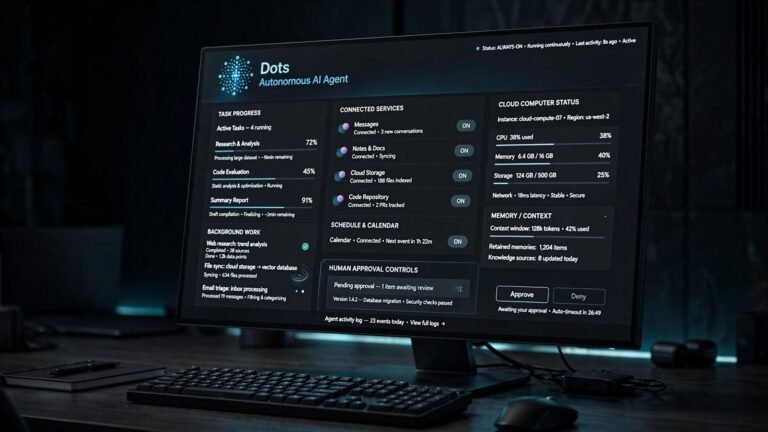
An AI agent can receive a goal, understand the situation, decide what steps are needed, use different tools, evaluate results, and continue working toward the objective.
For example, a traditional automation system might send an email whenever someone fills out a form.
An AI agent could potentially:
- Read the customer’s message
- Understand the customer’s problem
- Search a knowledge base
- Decide what information is needed
- Draft a personalized response
- Update the CRM
- Create a support ticket
- Escalate difficult cases to a human
- Follow up later
This difference makes AI agents more powerful than many earlier automation systems.
It also explains why businesses are paying attention to them.
AI Agents Are Replacing Tasks Before They Replace Jobs
One of the biggest misunderstandings about AI and employment is treating a job as one single activity.
Most jobs are actually collections of many tasks.
Consider a marketing manager.
The job might include:
- Research
- Writing
- Data analysis
- Meetings
- Strategy
- Reporting
- Customer research
- Campaign planning
- Communication
- Decision-making
An AI agent may be able to automate research, reporting, data analysis, and parts of content creation.
But that does not automatically mean the marketing manager disappears.
Instead, the role changes.
The employee may spend less time producing routine work and more time deciding what the company should do next.
This distinction is important because AI adoption often changes the composition of work rather than eliminating the entire occupation.
The World Economic Forum expects the proportion of work performed mainly by humans to decline as technology becomes more capable, while human-machine collaboration becomes increasingly important.
Which Jobs Are Most Vulnerable to AI Agents?
AI agents are particularly useful when work contains repetitive, predictable, digital tasks.
Jobs and responsibilities that involve large amounts of structured information are generally easier to automate.
Examples include:
Administrative Work
AI agents can help with:
- Scheduling
- Data entry
- Document processing
- Email organization
- Report generation
- Meeting summaries
- Basic customer communication
Administrative roles may therefore experience significant changes.
Customer Support
AI agents can answer common questions, troubleshoot simple problems, classify requests, and route complicated cases.
Human agents may increasingly handle the conversations where empathy, negotiation, judgment, or complex problem-solving is required.
Basic Content Production
AI can already generate:
- Product descriptions
- Social media posts
- Basic articles
- Email drafts
- Summaries
- Advertising variations
This does not necessarily eliminate writers, but it can reduce demand for certain types of repetitive writing.
Data Processing
AI agents can analyze large amounts of information much faster than humans.
They can identify patterns, summarize documents, compare datasets, and generate reports.
However, human professionals may still need to determine whether the analysis is correct and what action should be taken.
Basic Software Development
AI coding tools can generate code, explain errors, write tests, and help developers work faster.
This could reduce the amount of time developers spend on repetitive coding.
At the same time, it increases the value of developers who understand architecture, security, product requirements, and complex systems.
Will AI Agents Replace Entry-Level Jobs?
This may be one of the biggest concerns for young workers.
Entry-level positions often include repetitive tasks that are easier for AI systems to perform.
For example, a junior employee may previously have spent hours:
- Creating reports
- Researching information
- Writing basic documents
- Organizing spreadsheets
- Answering common questions
- Preparing presentations
AI agents can now perform portions of these tasks.
That creates a potential problem.
If companies automate too much entry-level work, young workers may have fewer opportunities to gain experience.
Recent research from PwC found that AI-exposed entry-level roles are increasingly requiring skills traditionally associated with more senior positions, including judgment and leadership.
This suggests that the entry-level career path may change.
Instead of starting by doing large amounts of routine work, new employees may be expected to use AI tools from the beginning and demonstrate stronger judgment, communication, and problem-solving skills.
AI Agents May Create More Jobs Too
It is easy to focus only on job losses.
But technological change can also create entirely new categories of work.
AI adoption is increasing demand for roles involving:
- AI development
- AI operations
- Data analysis
- AI governance
- Cybersecurity
- AI training
- Automation management
- AI implementation
- Human-AI workflow design
The World Economic Forum identifies AI and machine-learning specialists and other technology-related roles among the fastest-growing occupations toward 2030.
The important point is that the labor market does not remain static.
When technology eliminates certain tasks, companies often reorganize work around new capabilities.
The skills people need change as well.
AI Agents vs Human Workers: Who Is Better?
The answer depends on the task.
AI agents are extremely strong at certain types of work.
AI agents are good at:
- Processing large datasets
- Repetitive tasks
- Fast information retrieval
- Pattern recognition
- Drafting content
- Working continuously
- Repeating workflows
- Handling large volumes of routine requests
Humans remain especially valuable for:
- Judgment
- Leadership
- Empathy
- Trust
- Negotiation
- Complex decision-making
- Creativity
- Accountability
- Relationship building
- Understanding social context
This means the future workplace may not be a competition between humans and machines.
It may be a combination.
A skilled worker using AI can potentially outperform a worker who refuses to use AI.
The Rise of the AI-Augmented Worker
One of the most important workplace trends is the rise of the AI-augmented worker.
Instead of doing everything manually, employees can delegate certain tasks to AI agents.
For example, a sales employee could ask an AI agent to research a prospect, summarize previous interactions, prepare a briefing, and draft a personalized email.
The human then reviews the information and makes the final decision.
The same model can work in many industries.
A lawyer can use AI for document review.
A marketer can use AI for research and campaign analysis.
A developer can use AI for coding assistance.
A teacher can use AI to prepare learning materials.
A business owner can use AI to analyze customer feedback.
In each case, AI handles part of the workload while the human remains responsible for important decisions.
Microsoft’s 2026 Work Trend Index describes this shift as AI and agents taking on more execution while humans gain more room to direct work, make decisions, and own outcomes.
What Skills Will Become More Important?
If AI can perform more technical and repetitive tasks, what should humans learn?
The answer is not to avoid technology.
Workers should learn how to work with technology.
Important skills increasingly include:
AI Literacy
Employees should understand what AI can and cannot do.
You do not necessarily need to become an AI engineer.
But you should know how to use AI tools effectively and evaluate their output.
Critical Thinking
AI can produce incorrect information with confidence.
Human workers need to verify information, identify errors, and make informed decisions.
Communication
Clear communication remains important because people still need to explain goals, negotiate decisions, work with teams, and build relationships.
Creativity
AI can generate ideas, but humans still provide context, taste, goals, and direction.
Leadership
Organizations need people who can decide how technology should be used and how teams should adapt.
Problem-Solving
The ability to understand a complex problem and decide what should happen next can become more valuable as AI handles routine execution.
The International Labour Organization’s 2026 research also highlights growing demand for digital and AI skills alongside cognitive, socioemotional, adaptability, resilience, and human-agency skills.
What About Jobs That Require Human Empathy?
Not every job can easily be converted into an automated workflow.
Healthcare, education, counseling, leadership, sales, hospitality, management, and many service professions involve human relationships.
Imagine a teacher.
AI can create lesson plans, explain concepts, generate quizzes, and analyze student performance.
But a teacher also needs to understand when a student is frustrated, confused, anxious, or motivated.
That human relationship is difficult to reduce to a simple automated process.
The same applies to healthcare.
AI can help doctors analyze information, but patients still value communication, trust, empathy, and human accountability.
This does not mean these professions are immune to AI.
It means AI is more likely to become part of the job rather than the entire job.
Could AI Agents Eventually Replace Entire Jobs?
Yes, some occupations may eventually shrink dramatically.
If an AI agent can perform nearly every economically valuable task associated with a role at lower cost and acceptable quality, companies may need fewer workers in that occupation.
This is a real possibility.
But it is difficult to predict exactly which jobs will disappear and how quickly.
Technology adoption depends on more than technical capability.
Businesses also consider:
- Cost
- Reliability
- Regulation
- Security
- Customer expectations
- Legal responsibility
- Integration costs
- Employee acceptance
An AI agent may technically be capable of performing a task, but a company may still prefer human oversight.
That is why “AI can do this” does not automatically mean “AI will replace every worker doing this.”
The Biggest Risk May Be Job Transformation
The biggest impact of AI agents may not be mass unemployment.
It may be job transformation.
A worker may keep the same job title but perform completely different tasks.
For example:
Before AI:
Research → Writing → Reporting → Manual analysis → Meetings
With AI agents:
AI research → Human review → Strategy → AI execution → Human decision-making
The worker still has a job.
But the value of the worker has shifted.
This is why learning new skills is becoming so important.
What Should Businesses Do?
Companies should not treat AI agents simply as tools for cutting employee numbers.
A better approach is to redesign work.
Businesses can:
- Identify repetitive tasks
- Automate low-value workflows
- Train employees to use AI
- Keep humans involved in important decisions
- Create new AI-supported roles
- Measure productivity and quality together
- Establish clear AI governance
- Protect customer and employee data
The strongest organizations may be those that combine AI efficiency with human expertise.
PwC’s 2026 Global AI Jobs Barometer found that companies more capable of using AI were experiencing stronger headcount and wage growth than less AI-exposed companies, suggesting that AI adoption does not automatically mean shrinking employment.
What Should Workers Do to Stay Valuable?
Workers do not need to panic.
But they should adapt.
A useful strategy is:
Learn your profession + learn AI + develop human skills.
For example, a writer who understands AI-assisted research, editing, SEO, storytelling, and audience psychology may be more valuable than a writer who only produces text manually.
A marketer who knows how to build AI-powered workflows can potentially manage more campaigns with the same amount of time.
A developer who understands AI coding tools can spend more time on architecture and complex problems.
The goal should not be to become “better than AI.”
The goal should be to become better at using AI.
Will AI Agents Replace Human Workers or Create a New Workforce?
The most realistic answer is both.
Some workers will lose tasks.
Some jobs will shrink.
Some roles will disappear.
Other jobs will grow.
New occupations will emerge.
And many existing jobs will be redesigned around human-AI collaboration.
The World Economic Forum estimates that by 2030, 170 million jobs could be created while 92 million could be displaced by broader labor-market trends, resulting in a net increase of 78 million jobs.
That does not mean every worker will benefit equally.
Workers who already have strong digital skills may adapt faster.
Workers in highly repetitive roles may face greater disruption.
And people entering the workforce may need to develop useful skills earlier than previous generations.
The Future of Work Is Human + AI
The debate around AI often creates two extreme predictions.
One side says AI will replace almost everyone.
The other says AI will have little effect on employment.
The reality is more complicated.
AI agents are already changing how work gets done.
They can automate repetitive tasks, increase productivity, support decision-making, and allow small teams to accomplish more.
At the same time, humans continue to provide judgment, creativity, leadership, empathy, accountability, and real-world context.
The future workplace is therefore likely to be less about humans versus AI and more about humans working through AI.
The workers who adapt may gain an advantage.
The companies that redesign their workflows intelligently may become more productive.
And the jobs that survive may look very different from the jobs we recognize today.
Frequently Asked Questions
Are AI agents replacing human workers?
AI agents are replacing some tasks performed by humans, but they are not replacing all human workers. Their biggest impact is currently task automation, job transformation, and increased productivity.
Will AI agents replace jobs in the future?
Some jobs may decline or disappear as AI becomes more capable. However, other jobs will grow and new roles will emerge around AI, data, technology, and human-AI collaboration.
Which jobs are most at risk from AI agents?
Jobs with repetitive, predictable, digital tasks are generally more exposed. Administrative work, basic data processing, routine customer support, and some forms of content production may experience significant automation.
Will AI replace entry-level jobs?
Some entry-level tasks are likely to become automated. This could make entry-level roles more competitive and increase demand for judgment, communication, problem-solving, and AI skills.
Is AI better than humans?
AI is better at many high-volume and repetitive tasks. Humans remain stronger in areas such as empathy, leadership, complex judgment, accountability, and many forms of relationship-based work.
What skills should I learn because of AI?
AI literacy, critical thinking, communication, creativity, problem-solving, adaptability, leadership, and domain expertise are valuable skills for an AI-driven workplace.
Should workers be afraid of AI agents?
Workers should take AI seriously but focus on adaptation rather than fear. Learning how to use AI effectively can help employees become more productive and valuable.
What is the future of work with AI agents?
The future is likely to involve more collaboration between humans and AI agents. AI will handle more execution and routine work, while humans increasingly focus on direction, judgment, strategy, relationships, and accountability.
Final Thoughts
So, are AI agents replacing human workers?
They are replacing some tasks, changing many jobs, and creating new opportunities—but the complete replacement of human workers is not the current reality.
The biggest change is that the definition of a job is evolving.
Workers who once spent hours performing repetitive tasks may increasingly supervise AI systems, review their outputs, solve complex problems, communicate with customers, and make strategic decisions.
For businesses, the challenge is to use AI without losing the human capabilities that create trust, creativity, and accountability.
For workers, the message is simple:
Do not compete with AI on tasks AI is designed to automate. Learn how to use AI while becoming stronger at the skills that machines cannot easily replace.
The future may not belong to AI alone.
It may belong to the people who know how to work effectively with it.