
Data has become one of the most valuable resources for modern businesses. Companies collect information from websites, customers, social media, sales platforms, mobile applications, and many other sources. However, simply collecting data is not enough. Businesses need to analyze that information and turn it into useful insights.
Data analytics helps organizations understand what is happening, identify patterns, measure performance, and make better decisions. From small online businesses to large global companies, analytics can influence marketing, finance, customer service, product development, and everyday operations.
What Is Data Analytics?
Data analytics is the process of examining information to discover useful patterns, trends, and relationships.
For example, an online store might analyze its sales data to discover which products sell the most, which days generate the highest revenue, and where customers are coming from.
Instead of making decisions based only on assumptions, businesses can use real information to understand what is actually happening.
Why Is Data Important?
Good data can help businesses answer important questions.
A company might want to know:
- Which products are most popular?
- Where do customers come from?
- Which marketing campaigns perform best?
- Why are sales increasing or decreasing?
- Which pages receive the most website traffic?
- What do customers want?
Analytics can provide evidence that helps answer these questions.
For example, a website owner might discover that one article receives thousands of visitors while another receives very little traffic. This information can help determine what topics the audience finds most valuable.
Types of Data Analytics
There are several common types of analytics.
Descriptive Analytics
Descriptive analytics explains what happened.
Businesses can use dashboards and reports to review sales, website traffic, customer activity, or other historical information.
Diagnostic Analytics
Diagnostic analytics looks at why something happened.
For example, if website traffic suddenly decreases, analysts might investigate whether the change is related to search rankings, technical problems, seasonality, or changes in user behavior.
Predictive Analytics
Predictive analytics uses historical information and statistical methods to estimate what might happen next.
Businesses can use it to forecast demand, identify potential trends, or estimate future performance.
Prescriptive Analytics
Prescriptive analytics focuses on what action should be taken.
It can help businesses compare different options and determine which decision may produce the best outcome.
Data Analytics and Digital Marketing
Analytics is particularly important in digital marketing. Marketers can measure how people interact with websites, advertisements, emails, and social media campaigns.
For example, analytics can show:
- Website visitors
- Traffic sources
- Popular pages
- Conversion rates
- Search queries
- Engagement
- Returning visitors
This information allows marketers to improve campaigns instead of relying entirely on guesswork.
For more digital marketing and technology content, visit DailyScriptor.
The Importance of Data Visualization
Large amounts of information can be difficult to understand when presented only as spreadsheets or numbers.
Data visualization solves this problem by displaying information through charts, graphs, dashboards, and other visual formats.
A simple line chart can show whether website traffic is increasing or decreasing. A bar chart can compare sales across different products, while a geographic map can show where customers are located.
Good visualization makes complicated information easier to understand and communicate.
Data Quality Matters
Analytics is only as reliable as the data being analyzed. Incorrect, incomplete, outdated, or duplicated information can lead to misleading conclusions.
Businesses should therefore pay attention to data quality. Information should be collected consistently, checked for errors, and stored securely.
It is also important to understand where data comes from and whether it is appropriate to use for a particular analysis.
Protecting Customer Information
As companies collect more customer information, privacy and security become increasingly important.
Organizations should collect only the information they genuinely need, protect sensitive data, and follow applicable privacy regulations.
Customers are more likely to trust businesses that clearly explain how their information is collected and used.
Building a Data-Driven Culture
Having analytics software is not enough to make an organization data-driven. Employees also need to understand how to interpret information and use it responsibly.
Managers, marketers, product teams, and other departments can benefit from using relevant data when making decisions.
A strong data culture encourages employees to ask questions, test ideas, measure results, and learn from outcomes.
Data Analytics for Small Businesses
Data analytics isn’t only for large corporations. Small businesses can use relatively simple tools to monitor website traffic, sales, customer behavior, and marketing performance.
For example, a small blog can analyze which articles attract the most organic traffic and create more useful content around similar topics.
An online store can identify its best-selling products and adjust inventory accordingly.
For more business, technology, and analytics-related stories, explore DailyScriptor’s latest content.
Frequently Asked Questions
1. What is data analytics?
Data analytics is the process of examining data to identify patterns, trends, relationships, and useful insights that can support better decisions.
2. Why is data analytics important?
It helps businesses understand performance, identify problems, discover opportunities, and make decisions based on evidence rather than assumptions.
3. What tools are used for data analytics?
Common tools include spreadsheets, databases, business intelligence platforms, statistical software, and programming languages such as Python and R.
4. Can small businesses use data analytics?
Yes. Small businesses can analyze website traffic, sales, customer behavior, marketing results, and other information using affordable or free tools.
5. Is data analytics the same as data science?
Not exactly. Data analytics generally focuses on examining existing data to answer business questions, while data science can involve advanced statistics, machine learning, modeling, and predictive systems.
Final Thoughts
Data and analytics are changing the way organizations understand their customers and make decisions. The real value of data doesn’t come from collecting huge amounts of information; it comes from asking useful questions and turning reliable information into meaningful action.
Whether you’re running a blog, online store, marketing agency, or large organization, developing a better understanding of your data can help you identify opportunities, solve problems, and make more informed decisions.
How did you find this article?
Your feedback helps us improve.
Thank you for your feedback!
You finished this article!
Great job! Here are 3 more articles you might enjoy.
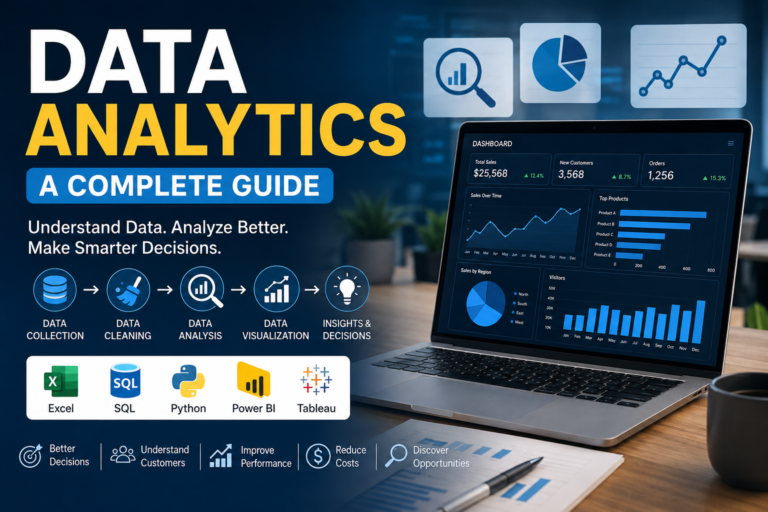
Data Analytics: A Complete Guide to Understanding Data Tools Benefits and Career Opportunities
11 min read